
It's Not Just You: No One Can Afford This
Current economic indicators are flashing red.
The Hidden Problem
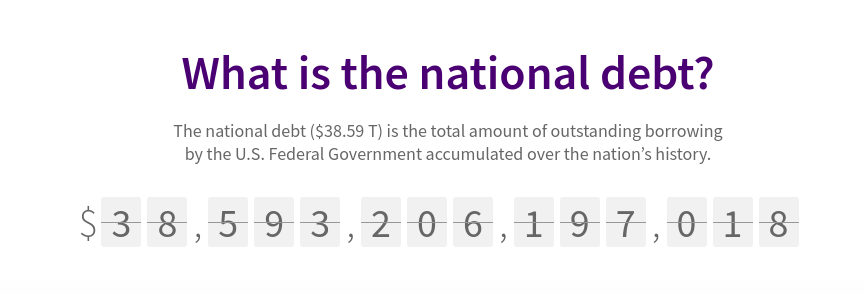
At a whopping $38.5 Trillion, our national debt is the highest it has ever been, and growing at a rate faster than ever before. We either have to borrow money (Treasury bonds) or we have to print more money. Both increase inflation, making everything more expensive.
You can think of money as something that is bought and sold, and interest is the cost to access money. The lenders sell money to borrowers for a price (interest).
Personal Cost
Right now, the government is borrowing money short term just to pay the interest on our current loans. That means the debt is not being paid down – we’re not even making the minimum payment on our “credit cards”. Last year it worked out to roughly $7600 per household just for the interest on the national debt. How many house or rent payments is that for you?
Who buys the Treasury bonds - who is the “bank”? Countries like China, Japan, UK, and EU countries. Also many of our individual retirement funds buy Treasury bonds. They are the bankers and you and I are the borrowers. Our government spends the money and we get the bill.
What happens when the “bank” decides that you are not a good credit risk; when they start to have doubts about your ability, or willingness to pay back your loan? They either stop lending money, or they charge a higher price to lend money.
As our debt and spending continue to grow, there’s an increasing chance that we can go from paying roughly 4% to 10% interest. If that happens, it could mean doubling that $7600 bill we spent on the interest payments last year. Can you afford to pay that?
Our huge, growing debt drives up interest rates for all of us. Consider that the national debt consumes a significant amount of the total money supply. When you need to borrow money for a home, car, credit card, or loan, you’re competing for a smaller piece of the total money supply. Increased demand relative to supply equals higher interest rates and higher prices.
Everything is more expensive.
Global Signals
Countries are also reducing the amount of US dollars they hold and are buying gold, silver, and currencies from other countries. These are clear signals that they’ve decided that the United States is an increasingly risky bet. These moves reduce the buying power of the dollar, which means your dollar today isn’t worth a dollar tomorrow.
And finally, there are tariffs placed on much of what we buy, or that goes into what we buy like lumber, steel, aluminum, and fertilizer. That’s 10%, 25%, or 100% additional cost depending on the day and the president’s mood.
The uncertainty around tariffs and the higher costs to access money makes it difficult for companies to make long term decisions about expansion and hiring. The safer bet is to stay pat and not hire.
So, every dollar you make is worth less, buys less, and is taxed more. How can you possibly catch up?
The Path Forward
What do you do when you’re at the bottom of a hole? You stop digging.
If this were your household financial situation, you would take a very serious look at what expenses are critical, what is important, and what is nice to have. You would cut what is nice to have. You would negotiate payments on what is important, and you would prioritize paying what is critical. And you would look at what you could sell to get money immediately, and work overtime hours or even get a second job to increase your income.
Being in this situation is uncomfortable, and can even be painful. But you stop digging and you start getting yourself out of that hole.
The national debt must be brought under control or it will bankrupt us. We need to reduce spending and increase revenue to get us out of this hole.
Congress must take this crisis seriously and we need to help them see that. Congress alone controls federal spending. They alone choose how much to spend, and which services to fund. They alone choose what to tax and how much to tax.
For example, Congress could choose to raise taxes on the wealthy folks to whom they just gave a tax cut. Why on earth would we reduce our national income (taxes) at a time when our debt is increasing every minute? Would you cut your income if you were trying to get out of debt?
We can go bankrupt together, or we can solve this together.
Reach out to your congressional representatives. Demand action on out of control government debt. Tell them that you are concerned about what the national debt means to you and your family’s future, and how it’s making your life less affordable today. Tell them to get to work!

Are you a storyteller with deep roots in your community?
Join our network. We provide the platform and resources. You share your indispensable local focus and insights to a national audience hungry for authentic, ground-level journalism.